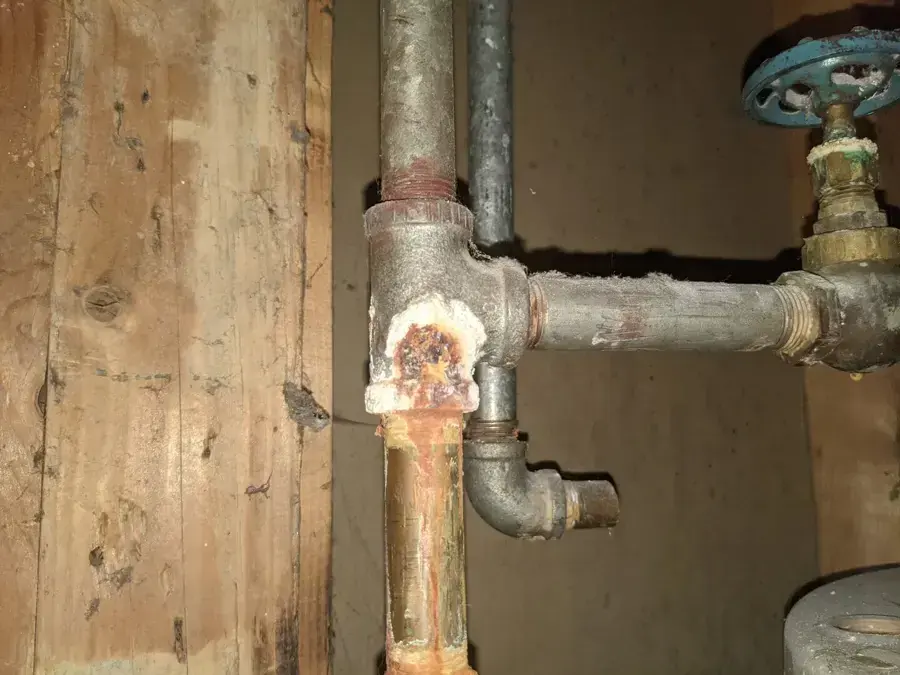
San Pablo grew fast during World War II, and many of its small homes still carry the steel supply pipe that was installed when they were new. That pipe rusts from the inside out, so the first sign of trouble is often a damp patch rather than a gush.
Key takeaways
- Original galvanized steel supply pipe corrodes from the inside, so a leak can start long before any stain shows.
- Small homes from the 1940s and 1950s on raised wood floors hide slow leaks over a crawl space.
- Low pressure, brown water and a musty smell near a wall or floor are reasons to have the pipe checked.
- Shut off the water at the main valve first, then call for moisture mapping before anything is torn out.
- Drying the framing and subfloor to a reading matters more than drying what is visible.
Why so many San Pablo homes still carry galvanized pipe
San Pablo boomed when Richmond shipyard workers filled the flatlands during World War II, and the homes built to house that wave were small, quick to build and plain in their plumbing.
Much of that housing is still standing. Single story houses from the 1940s and 1950s sit on raised wood floors over a crawl space, and apartment buildings stand along 23rd Street and San Pablo Avenue.
Galvanized steel was a normal choice for supply pipe in those decades. Where it was never replaced, the original pipe is now doing the same job it did when the neighborhood was new.
How galvanized pipe turns into a leak
Corrosion from the inside
Galvanized pipe is steel with a zinc coating. Over many years water wears the coating down, and rust and mineral scale build up on the inner wall.
The pipe narrows, pressure drops and the thinned wall eventually weeps.
Where the weeping starts
Threaded joints and fittings are common weak points, because the threads cut through the coating and the metal is thinnest there.
A pinhole can spray a fine mist inside a wall cavity for weeks. The drywall wicks the water upward while the floor below stays dry on the surface.
- Water pressure that fades at one faucet or fixture
- Brown or rust tinted water after the tap sits unused
- A damp or swollen baseboard on a wall that shares a pipe run
- Peeling paint or a soft patch in drywall near a kitchen or bathroom
A slow leak is not a split pipe
A split pipe is dramatic and obvious. Water sprays, the owner shuts the valve, and the damage is limited to the area around the break.
A galvanized seep behaves differently. It can run quietly for a long stretch, so the wet area is larger and older when it is finally found.
That difference changes the cleanup. A fresh split pipe is mostly a burst pipe water damage job of extraction and quick drying, while a long seep may involve damp insulation, swollen trim and a wet subfloor.
- Sudden spray points to a split or failed fitting.
- A slow rise in the water bill or a faint hiss in the wall points to a seep.
- Stains that grow slowly along a wall point to a leak inside the cavity.
What the leak does under a raised wood floor
Most older San Pablo homes sit above a crawl space, so water that leaves a pipe does not stop at the floor. It drips down through the subfloor and onto the soil, the insulation and the joists.
Wood framing that stays wet picks up a damp smell and can swell, stain and begin to soften. Vents in the foundation do not dry a soaked cavity on their own, especially during the wet winters that run from about November to March.
When the water collects below the house, a crew treats it as a crawl space water damage job. That means pumping out any standing water, pulling wet insulation and drying the joists and subfloor with air movers and dehumidifiers.
First steps when a galvanized leak is suspected
The first move is to stop the water. The second is to avoid guessing about how far it has spread.
- Close the main shutoff valve, then open a low faucet to relieve pressure.
- Switch off power to wet areas if outlets or the water heater closet are involved.
- Photograph stains, wet trim and any visible corrosion before anything moves.
- Lift small rugs and move furniture away from the wet wall.
- Do not cut into drywall to look. Moisture readings show where the water went without extra demolition.
Mapping, opening up and drying
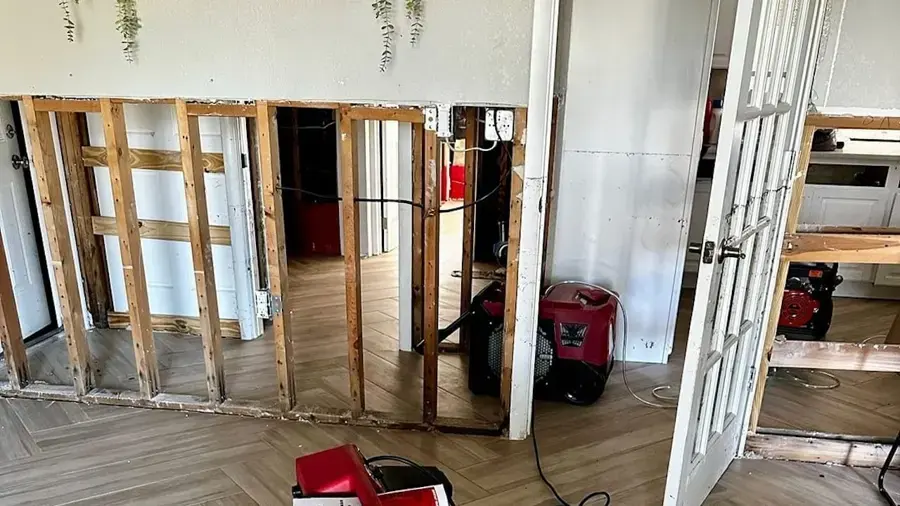
A restoration crew starts with a moisture meter and, where needed, a thermal camera. The readings show whether the water stayed in one wall or travelled along the floor framing.
Only the materials that cannot be dried are removed. Wet insulation and soaked drywall near the break usually go, while framing and subfloor are dried in place.
The homeowner can compare what is being done with the work on the galvanized pipe leak service page, and the galvanized pipe risk check is a simple way to judge how exposed an older home may be.
- Moisture mapping of walls, floors and the crawl space
- Controlled openings only where meters show wet cavities
- Air movers and dehumidifiers running with daily readings
- A final reading that confirms the framing is back to normal before closing up
Reducing the chance of a repeat
A leak in one fitting is a hint about the rest of the pipe. If the same galvanized run is still in the wall, other joints are aging in the same way.
Many owners ask a plumber to assess the whole system while the wall is open, because a repair at one spot does not stop corrosion at the next. A plumber decides on replacement, and the restoration crew works around that schedule so the drying is finished before walls are closed.
Questions
How can a homeowner tell a galvanized pipe is failing?
Common signs are falling pressure, brown water after the tap has sat unused and damp patches near a wall that carries supply pipe. A plumber can confirm the pipe type and condition.
Can a slow pipe leak damage the floor without any visible puddle?
Yes. Water can travel down through the subfloor into a crawl space or along framing, so the wet area is often much larger than the stain on the surface.
Should the drywall be cut open to look for the leak?
Not before readings are taken. Moisture mapping shows where water went, and openings are then made only where the meters point.
Who replaces the pipe, the plumber or the restoration crew?
A plumber replaces or repairs the supply pipe. The restoration crew extracts water, dries framing and subfloor, and coordinates timing so walls are not closed while they are still wet.
Does a galvanized leak always mean the whole house must be repiped?
Not always. The plumber judges how much of the pipe is worn, and a leak at one spot can still be a sign that other joints are aging in the same way.